Elevating a house in Pinellas County typically costs $150,000 to $300,000 all-in for a typical one-story home, covering the structural lift, a new elevated foundation, reconnecting utilities, new stairs and access, and finishing the space underneath. Homes in VE (coastal high hazard) zones like Tierra Verde, Pass-a-Grille, and the barrier islands often need a pile foundation, which adds another $50,000 to $100,000. The lift itself is a fraction of the total; the foundation and everything that has to be rebuilt around the raised house are where the money goes.
After Helene and Milton put water into tens of thousands of Pinellas homes, elevation went from a niche project to a dinner-table conversation. This guide lays out what the cost is made of, what help exists, and when raising a house makes sense versus rebuilding.
What is included in the cost to elevate a house
- Engineering and design: $10,000 to $30,000. A structural engineer designs the lift plan and the new foundation; a surveyor provides the elevation certificate; the design has to satisfy the floodplain office and Florida Building Code wind requirements.
- Permits and inspections. A house elevation is a substantial improvement by definition and gets a full review.
- Disconnecting utilities. Water, sewer, gas, electric, and HVAC all come loose before the lift.
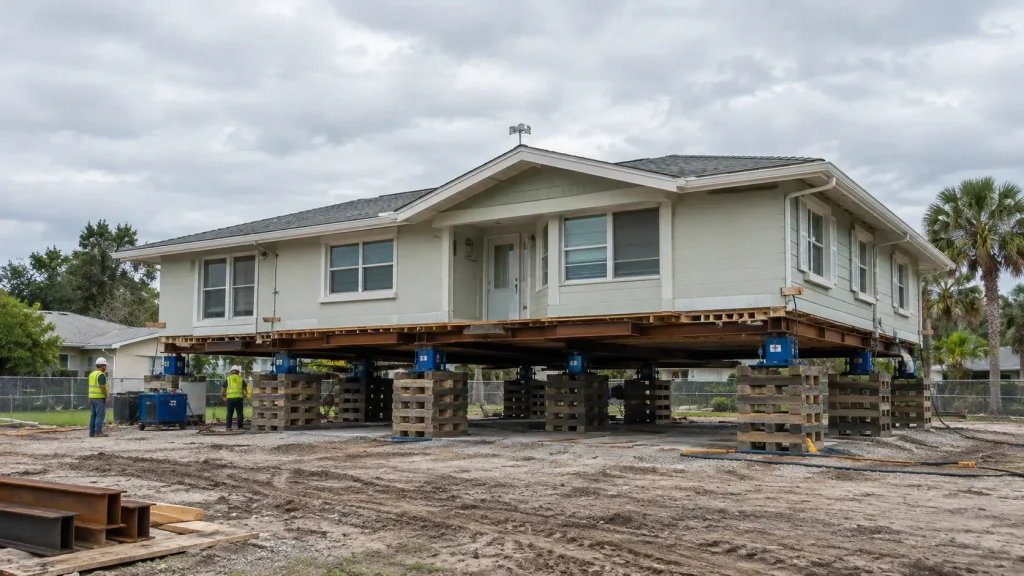
- The lift: roughly $40,000 to $100,000+. A specialty house-moving contractor threads steel beams under the structure and raises it on hydraulic jacks and cribbing. Slab-on-grade homes, which are most of Pinellas, cost more to lift than crawlspace homes because the slab either comes up with the house or the house is separated from it.
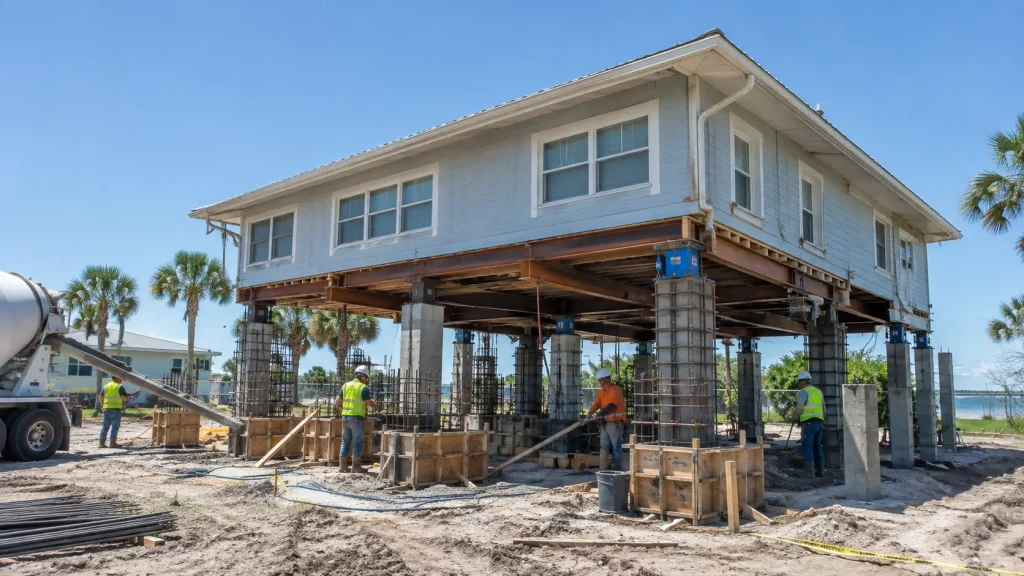
- The new foundation. Concrete block piers, poured columns, a stem wall, or driven piles, built under the suspended house. This is usually the largest single line item and is what separates a $150,000 project from a $300,000 one.
- Setting the house down and tying it in. Anchoring to the new foundation with connectors rated for Pinellas wind speeds.
- Reconnecting utilities and raising equipment. New plumbing and electrical runs, a raised AC condenser and water heater, and often a new panel.
- Stairs, landings, ramps, and porches. A house that used to be one step up is now five to nine feet up. Every entrance needs code-compliant access.
- The space underneath. In AE zones, enclosed areas below the BFE are limited to parking, storage, and access, must have flood vents, and must use flood-resistant materials. Many homeowners build a carport or open lattice instead of walls.
- Exterior and interior repairs. Stucco, siding, drywall cracks, and driveway and landscaping repair after the equipment leaves.
What changes the price
- Slab vs. crawlspace. Slab homes are more complex and more expensive to lift.
- Foundation type required. Block piers in an AE zone are far cheaper than driven piles in a VE zone.
- Height. Raising a home two feet costs less than raising it eight, mostly in foundation and stair cost, but the difference is smaller than people expect once the equipment is on site.
- Size and shape. Larger footprints and L-shaped or multi-wing homes need more steel and more time.
- Attached structures. Garages, porches, and additions built at different times often have to be lifted separately or demolished and rebuilt.
- Soil. Sandy fill and organic soils near the water may require a geotechnical report and deeper foundations.
- Site access. Tight lots in older St. Petersburg neighborhoods limit crane and equipment placement.
Financial help: what exists and what to expect
Elevate Florida
The state’s Elevate Florida program, created after Helene, offered to cover about 75 percent of elevation, reconstruction, or wind mitigation costs using federal Hazard Mitigation and Flood Mitigation Assistance funds, with the homeowner paying 25 percent. Applications were open from February 7 to April 11, 2025, and more than 12,000 Florida households applied. Applications are closed. As of mid-2026, only a small number of projects had received final FEMA funding awards, and many Pinellas applicants were still waiting; state lawmakers have pressed Congress and FEMA to speed things up. If you applied, stay in contact with your case manager. If you did not, watch for future funding rounds, but do not build your plan around them.
Increased Cost of Compliance (ICC)
If you carry an NFIP flood policy and your home was substantially damaged by flooding, ICC coverage can pay up to $30,000 toward elevating, relocating, demolishing, or floodproofing the home to meet current code. It is part of most standard NFIP policies and is paid in addition to your building claim. Ask your agent and your floodplain office; the substantial damage determination has to come from the local government.
Other options
SBA disaster loans, FEMA Individual Assistance in declared disasters, local mitigation grants, and conventional renovation financing. A design-build contractor experienced with FEMA compliance can help you sequence the paperwork so a grant application and a permit application do not contradict each other.
Elevate, rebuild, or repair: how to decide
Three questions drive the decision:
- Where does the home sit relative to the base flood elevation? Get the elevation certificate. A home a foot below BFE is a very different case from one four feet below.
- Does the repair cross the 49 percent threshold? In Pinellas County, a repair or improvement costing 49 percent or more of the structure’s market value requires bringing the whole home into compliance. If a storm repair already puts you near that line, elevation may be required, not optional. Our post on the FEMA 50 percent rule explains the math and how an independent appraisal can help [LINK: The FEMA 50% Rule (49% in Pinellas) — post pending].
- What is the house worth elevated versus the cost of a new elevated home? When lift plus foundation plus repairs approaches the cost of demolishing and building a new code-compliant home, rebuilding usually wins: you get a new structure, modern wind design, and a floor plan you chose.
There is no universal answer. A solid block ranch on a good lot in Shore Acres is often worth elevating. A frame cottage that took five feet of water may not be.
How long does it take to elevate a house?
Plan on 9 to 18 months from first meeting to moving back in: engineering and permitting can take three to six months on their own, the lift and foundation work several months more, and utility reconnection, access, and repairs after that. You cannot live in the house during the lift and foundation phases.
Work with a contractor who knows the flood rules
House elevation sits at the intersection of structural engineering, FEMA floodplain rules, Florida wind code, and grant paperwork. The general contractor coordinates the house-lifting specialist, the foundation crew, the utility trades, and the floodplain office. Our FEMA compliance team in Seminole works with homeowners across St. Petersburg, the beaches, and the rest of Pinellas County to evaluate whether elevation makes sense, what it will cost for your specific house, and how to design the raised home so it looks like it was built that way.
Frequently Asked Questions
How much does it cost to lift a house in Florida?
The lift alone often runs $40,000 to $100,000 or more, but the complete project including the new foundation, utilities, stairs, and repairs typically totals $150,000 to $300,000 in Pinellas County, and more in VE zones requiring piles.
Can you elevate a slab house?
Yes. Slab-on-grade homes, which are most of Pinellas County’s housing stock, can be lifted either with the slab attached or by separating the walls from the slab. Both methods cost more than lifting a crawlspace home.
Is Elevate Florida still accepting applications?
No. The application window closed April 11, 2025. Funding awards have been slow; as of mid-2026 most applicants were still waiting on FEMA approval. Watch the Florida Division of Emergency Management site for any future rounds.
Does flood insurance pay to elevate a house?
Standard NFIP policies include Increased Cost of Compliance coverage of up to $30,000 toward elevation or other compliance work after the home is declared substantially damaged by flood.
Is it cheaper to elevate a house or rebuild?
For a small or heavily damaged home, rebuilding on an elevated foundation is often comparable in cost and yields a new structure. For a sound block home on a good lot, elevation is usually less expensive. An engineer’s assessment and an elevation certificate are the starting point.
Ready to Talk to a Local Design-Build Team?
Van Selow Design Build is a licensed and insured design-build contractor (CBC1252610) based in Seminole, serving St. Petersburg, the Pinellas beaches, Belleair, Tierra Verde, and the rest of Pinellas County. We handle kitchens, bathrooms, home additions, ADUs, outdoor living spaces, and FEMA-compliant remodeling under one roof, from design through final inspection. If your home took water and you are weighing repair, elevation, or rebuilding and want straight numbers for your specific house, call 727-628-2219 or email info@vanselowdesign.com, or visit our contact page and we will set up a conversation about your home.