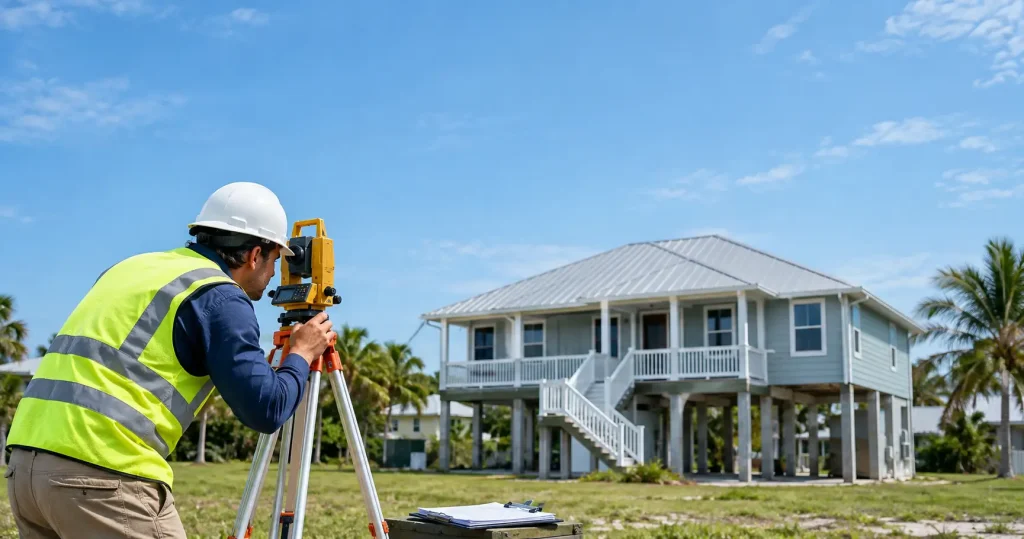
An elevation certificate (EC) is an official FEMA form, completed by a licensed surveyor, engineer, or architect, that records how high your home’s floors, equipment, and surrounding ground sit compared to the base flood elevation (BFE) for your property. It states your flood zone, your BFE, the elevation of your lowest floor, and details about your foundation and any flood openings. Floodplain managers use it to confirm a new or substantially improved home meets code, and insurers can use it to price a flood policy more accurately.
If you own a home in a Pinellas County flood zone, or plan to remodel one, an elevation certificate is one of the most useful documents you can have in a drawer. Here is what is on it, when you need it, and how to get one.
What an elevation certificate tells you
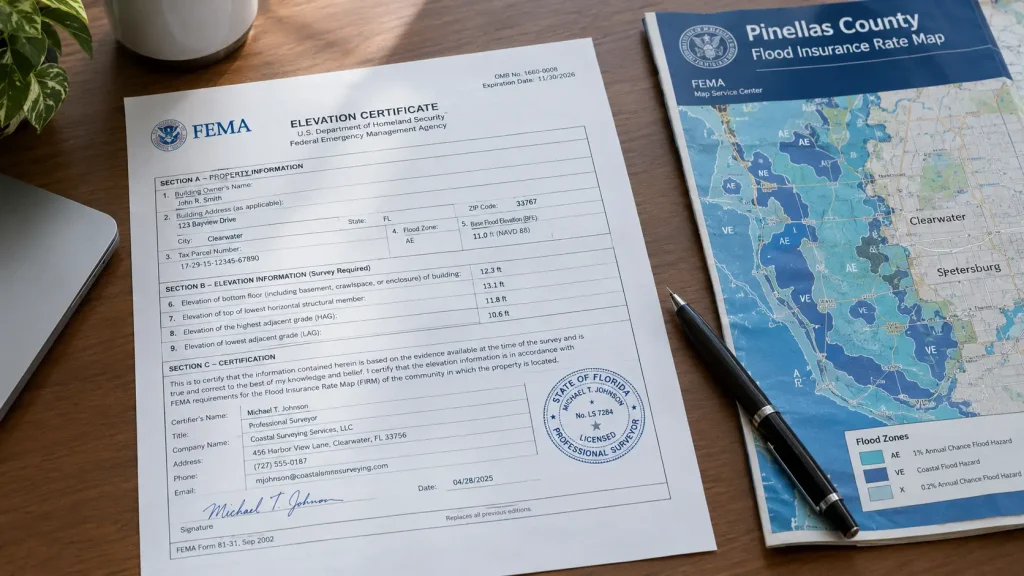
The form (FEMA Form FF-206-FY-22-152, previously numbered 086-0-33) runs several pages. The parts that matter to a homeowner:
- Flood zone and BFE for the property, pulled from the current Flood Insurance Rate Map. In Pinellas County, the effective maps date from August 24, 2021.
- Building diagram number. A code describing your foundation type: slab on grade, crawlspace, elevated on piers, and so on.
- Top of bottom floor. The elevation of your lowest floor, including a basement, crawlspace, or enclosure.
- Top of next higher floor. Important for elevated homes with a garage or storage underneath.
- Lowest elevation of machinery and equipment. Your AC condenser, water heater, and electrical panel.
- Lowest adjacent grade (LAG) and highest adjacent grade (HAG). Ground elevations next to the building.
- Flood openings (vents). Number and size of engineered openings in an enclosure below the BFE.
- Photographs of all sides of the building, required.
The number people care about most is the difference between the top of the bottom floor and the BFE. A home two feet above BFE is in good shape. A home two feet below it is where insurance costs and compliance problems live.
When you need an elevation certificate
- New construction in a Special Flood Hazard Area (AE, VE, A zones). Your floodplain office will require one before the permit is finaled to prove the lowest floor is at or above the required elevation.
- A substantial improvement. If your remodel or addition crosses the threshold (49 percent of structure value in Pinellas County), the home must be brought into compliance, and the EC documents that it was.
- Elevating a house. A post-construction EC proves the new height.
- Getting or challenging a flood insurance quote. Since the NFIP’s Risk Rating 2.0 pricing took effect in 2021, an EC is no longer required to get a policy. But if your home sits well above the BFE, submitting one can lower your premium, because the rating uses your actual first-floor height.
- Applying for a Letter of Map Amendment (LOMA). If your lot sits naturally above the BFE, an EC supports a request to remove it from the high-risk zone.
- Buying or selling a flood-zone home. Buyers increasingly ask for it, and it gives everyone a clear picture of the property’s risk.
Do you need one in Zone X?
Not for a permit, and not for insurance. But an EC still tells you how your floor compares to the nearest flood elevations, which is exactly what a Zone X homeowner near the bay learned to care about in 2024. See our post on what flood zone X means.
How to get an elevation certificate
First, check if one already exists
Many Pinellas homes already have an EC on file, especially anything built or substantially improved since the 1990s. Check with your city’s floodplain management office (St. Petersburg, Seminole, Largo, the beach communities, or Pinellas County for unincorporated areas). Several jurisdictions keep ECs searchable online. Also ask the seller, your title company, or the previous owner’s insurance agent. An existing EC is valid as long as the building and the flood map have not changed.
If not, hire a licensed surveyor
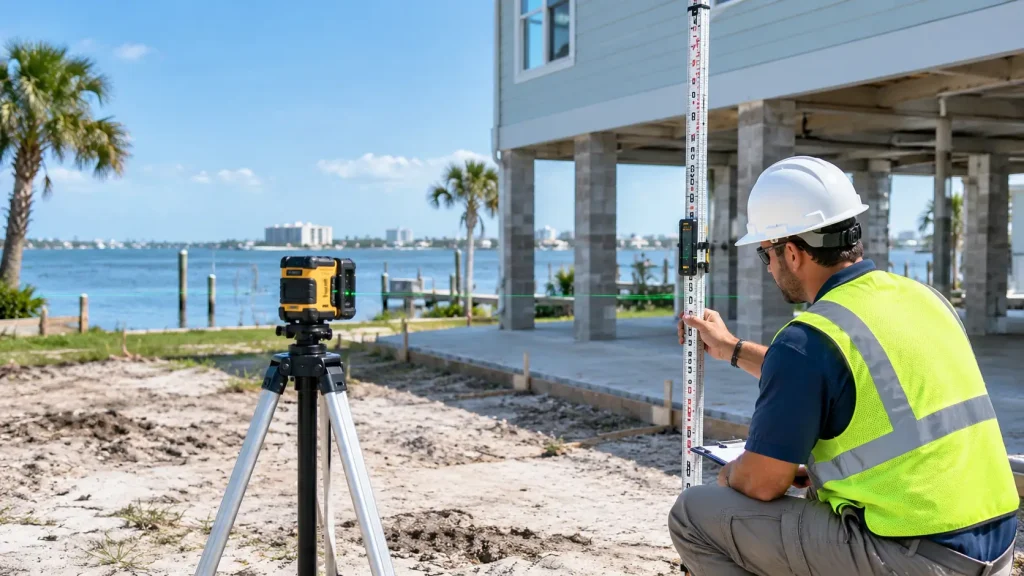
A Florida licensed land surveyor (or an engineer or architect authorized to certify elevations) completes the form on site. Expect to pay roughly $300 to $800 in Pinellas County depending on the property and how quickly you need it. Give them the address, the year built, and any prior surveys you have.
Send it to the right people
Give copies to your insurance agent, your floodplain office if the project requires it, and your contractor. Keep the original with your closing documents.
Elevation certificates and your remodel
For any project in an AE or VE zone, the EC is step one, before design. It tells your design-build contractor whether the home is already compliant, how much headroom you have under the 49 percent rule before compliance is triggered, and whether adding a sunroom, ADU, or second story changes the picture. If the home is below BFE and the project is big, the EC is also the starting point for the elevation conversation. Our companion post covers how much it costs to elevate a house in Pinellas County.
Our FEMA compliance team reviews the elevation certificate, flood zone, and structure value on every flood-zone project before we draw a line, so the design we present is one the floodplain office will approve.
Frequently Asked Questions
How much does an elevation certificate cost in Florida?
Typically $300 to $800 from a licensed surveyor in Pinellas County, depending on the property and turnaround time. Existing certificates on file with your city are usually free to obtain.
Do I need an elevation certificate for flood insurance?
Not since Risk Rating 2.0 began in 2021. But if your home sits above the base flood elevation, submitting one can lower your NFIP premium.
Who can complete an elevation certificate?
A licensed land surveyor, professional engineer, or architect authorized by law to certify elevation information. In Florida this is usually a surveyor.
Does an elevation certificate expire?
The certificate itself does not expire. It remains valid until the building changes or FEMA issues a new flood map for the area. The FEMA form version is updated periodically, but existing certificates remain usable.
Where can I find my home’s elevation certificate?
Start with your city or county floodplain management office, then the seller, title company, or prior insurance agent. Many Pinellas jurisdictions keep ECs on file for homes built or improved in recent decades.
Ready to Talk to a Local Design-Build Team?
Van Selow Design Build is a licensed and insured design-build contractor (CBC1252610) based in Seminole, serving St. Petersburg, the Pinellas beaches, Belleair, Tierra Verde, and the rest of Pinellas County. We handle kitchens, bathrooms, home additions, ADUs, outdoor living spaces, and FEMA-compliant remodeling under one roof, from design through final inspection. If you are planning a project in a flood zone and want the elevation, the 49 percent rule, and the design worked out together before construction starts, call 727-628-2219 or email info@vanselowdesign.com, or visit our contact page and we will set up a conversation about your home.